

Why Don't Your Guide Posts Last? Demystifying the "Four Longevity Genes" of Precision Guide Posts: The Crucial Roles of SUJ2 and Sub-zero Treatment
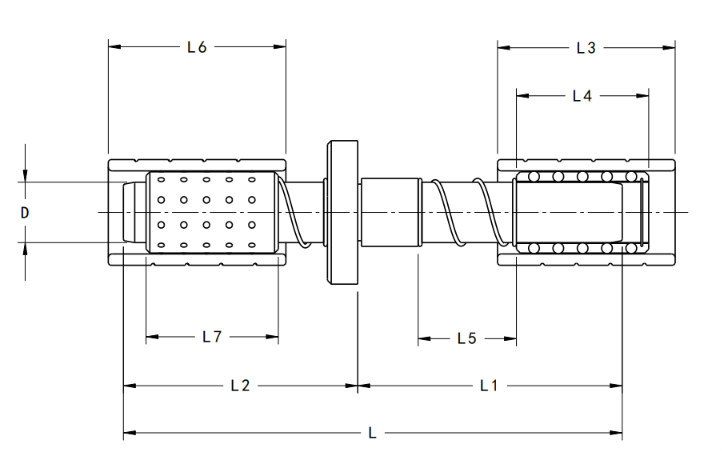
On the shop floor of precision automated assembly lines, you may have encountered this painful scenario: a high-speed driving mechanism starts making abnormal noises after millions of reciprocating cycles. The originally precise positioning points begin to drift by a few micrometers () in cumulative error, or worse, experience minor stuttering. Engineers repeatedly recalibrate the guide rails, yet the problem persists. In reality, the issue is often hidden within the core of the structure—the guide post assembly.
When a machine operates at high speeds, standard guide post assemblies subjected to slight eccentric loads can easily accelerate wear due to insufficient rigidity. Drawing on years of deep-rooted manufacturing experience in precision industrial components, Handway breaks down the "Four Longevity Genes" of top-tier Precision Cross-Type Stripper Guide Post Assemblies that can extend tool life by 3 to 5 times.
The "Four Longevity Genes" of Precision Guide Posts
1. SUJ2 High-Carbon Chromium Bearing Steel
The core is crafted from SUJ2 bearing steel, featuring exceptionally high wear resistance and fatigue strength. It effectively resists metal fatigue under high-frequency impacts, ensuring absolute resistance to bending over tens of millions of reciprocating cycles.
2. Induction Hardening & Sub-zero Treatment
The surface undergoes precise induction hardening to a depth of 1.5–2.0 mm, achieving a hardness of HRC 58–62. This is followed by Sub-zero Treatment, which completely transforms residual austenite and thoroughly eliminates internal stresses. This guarantees zero dimensional deformation even under long-term temperature fluctuations.
3. Super Finish to Below Ra 0.1
The surface undergoes a Super Finish process to achieve a mirror-like smoothness of below Ra 0.1. This ultimate smoothness minimizes frictional resistance and heat generation. Combined with a black oxide treatment on the guide bush to absorb lubricant, it fundamentally prevents wear and tear.
4. 2 µm Tolerance & JIS Grade 5 Steel Balls
Component tolerances are strictly locked within 2 . Utilizing a lightweight aluminum alloy retainer paired with high-sphericity JIS Grade 5 steel balls, the system achieves "zero-clearance" precision rolling guidance. Complemented by a "chamfer f8" design, assembly and positioning become effortless.
Precision Guide Posts FAQ
Q1: Why must Handeway's guide post assembly heat treatment include "Sub-zero Treatment"?
A: After standard quenching, residual stresses remain within the material, leading to micro-deformations over time. Sub-zero treatment stabilizes the metal's microstructure, locking in the ultra-precise 2 tolerance and preventing the machine from seizing due to micro-expansion of the guide posts during high-frequency operation.
Q2: Is the "Black Oxide (Blackening)" treatment on the guide bush surface purely for aesthetics?
A: Absolutely not. The black oxide process forms a microporous oxide film on the surface. Beyond basic rust prevention, its core function is to effectively absorb and retain lubricating oil, maintaining a stable protective oil film during high-frequency rolling.
Q3: What are the advantages of aluminum alloy retainers compared to traditional plastic retainers?
A: Aluminum alloy retainers combine lightweight properties with high rigidity. During high-speed reciprocating motion, they significantly reduce impact forces caused by inertia. Furthermore, unlike plastic materials, they will not embrittle or break due to long-term fatigue or chemical reactions with oils.
Q4: How can I prevent precision guide posts from being damaged by eccentricity during assembly?
A: Handway features a "chamfer f8" structure designed to facilitate concentric alignment during assembly. We recommend using precision instruments to verify coaxiality during installation. By leveraging the original guiding design, you can easily avoid localized stress concentration caused by forced insertion.
More Information


