

The Key to a 30% Space Reduction! How to Achieve Lightweight and Compact Designs in High-End Equipment Using the "Ball Spline KLF"
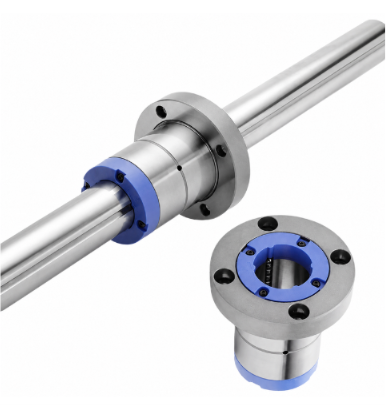
In modern design trends for semiconductor, optoelectronic panel handling, and medical automation equipment, "miniaturization" and "lightweighting" have become core challenges for engineers. However, to withstand sufficient torque and cantilever loads, traditional mechanisms often require larger shaft diameters or heavy external mounting bases. This results in a bulky overall structure, creating a major bottleneck for space reduction.
Today, from a structural engineering perspective, we will break down the key secret to achieving a 30% reduction in mechanism space without sacrificing rigidity, using the flanged ball spline KLF.
1. Integrated Round Flange: The Space Magic of Simplifying Complexity
When traditional mechanisms use conventional linear bearings combined with external keyways to transmit torque, the periphery usually requires complex outer cylinder mounting bases and positioning pins. The greatest structural advantage of the Headway KLF lies in its integrated round flange design.
The outer cylinder itself comes with a precision flange face and mounting holes. During the design phase, engineers can bolt the spline's outer cylinder directly onto the equipment structure. This streamlined design not only eliminates tedious secondary assembly time but also substantially reduces the surrounding installation space by up to 30%, allowing the machine to achieve an ultra-compact footprint.
2. Ten Times the Load Capacity: Small Size, Massive Torque
Does shrinking the volume mean structural strength must be sacrificed? Absolutely not. According to rigorous R&D and testing data from Headway, the KLF features an opposing 2 to 4-row ball design with a 40° contact angle. Its special "Gothic arch groove" maximizes the contact area between the balls and the raceway.
This technological breakthrough allows the KLF to withstand rated loads over ten times greater than traditional linear ball bushings of the same shaft diameter! Combined with precision preload adjustment (P0~P3), it achieves "zero backlash" in the rotational direction and more than doubles the rigidity.
The shaft and outer cylinder are crafted from premium alloy steels (such as SUJ2 and SCM440). After professional quenching heat treatment, they reach a hardness of HRC 58~62, ensuring top-tier wear resistance and a long lifespan even in compact sizes. Whether for SCARA industrial robots or high-speed labeling machines, the Headway KLF provides the most reliable transmission support within extreme space constraints.
Frequently Asked Questions (FAQ)
Q1: When pursuing ultimate "lightweighting," how should I choose the spline shaft type? According to the part numbering logic, in addition to the solid shaft (S), Headway offers a standard hollow shaft (K) and a thin-walled hollow shaft (N). The hollow structure significantly reduces shaft weight and rotational inertia, easing the motor load. Furthermore, the internal hollow bore can serve as a conduit for wiring or pneumatic lines, making it an excellent multi-purpose choice for achieving ultra-compact equipment.
Q2: How do I choose the number of ball rows (T2 vs. T4), and how does it affect compact design? The number of ball rows directly determines the torque-carrying capacity within a limited space. If installation space is constrained but high torque is required, choosing four rows of balls (T4) is key. Taking a 16mm shaft diameter from the specification table as an example, under the exact same outer diameter and installation dimensions, the dynamic rated torque (Ct) of the KLF16T4 reaches 81.81 N·m. This is nearly double the 46.75 N·m of the two-row (T2) version, perfectly embodying "small size, high output."
Q3: The cantilever mechanism carries a heavy load. How can I maintain a compact design without increasing the shaft diameter? When dealing with the overturning moments brought by cantilever structures, enlarging the shaft diameter would ruin a compact design. Instead, a dual outer cylinder configuration is highly recommended. Indicated as "B2" in the Headway part number, this configuration places two outer cylinders on a single spline shaft, multiplying bending and torsional rigidity without expanding the overall mechanism dimensions.
More Information


