

Why Did the Replacement Gear Fail in Less Than Three Months?
The production line is rushing to meet delivery deadlines when a high-speed braiding machine suddenly emits a piercing noise and then stops after a thread breaks. After opening the machine base, maintenance staff discover that the gear installed less than three months ago is already severely worn, with cracks or even fractures at the tooth root. Yet the purchase order only says “manufacture to sample; surface hardening required.” Should induction hardening or carburizing and quenching be used? Is the case depth sufficient? Can S45C medium-carbon steel withstand impact under high-tension loads? Is tooth-surface grinding required after heat treatment?
These problems are usually not caused by machining dimensions alone. They often arise because purchasing decisions are based only on price and sample matching, without confirming machine loads, steel grade, or heat-treatment specifications. Incorrect gear specifications can increase noise and backlash, causing yarn breakage; in more serious cases, teeth may chip or fracture and damage the entire drive mechanism. Any savings on the part itself can then be outweighed by downtime and disassembly and repair costs. Before purchasing, confirm the tension load, material, heat-treatment method, and tooth-surface accuracy—not just the unit price.
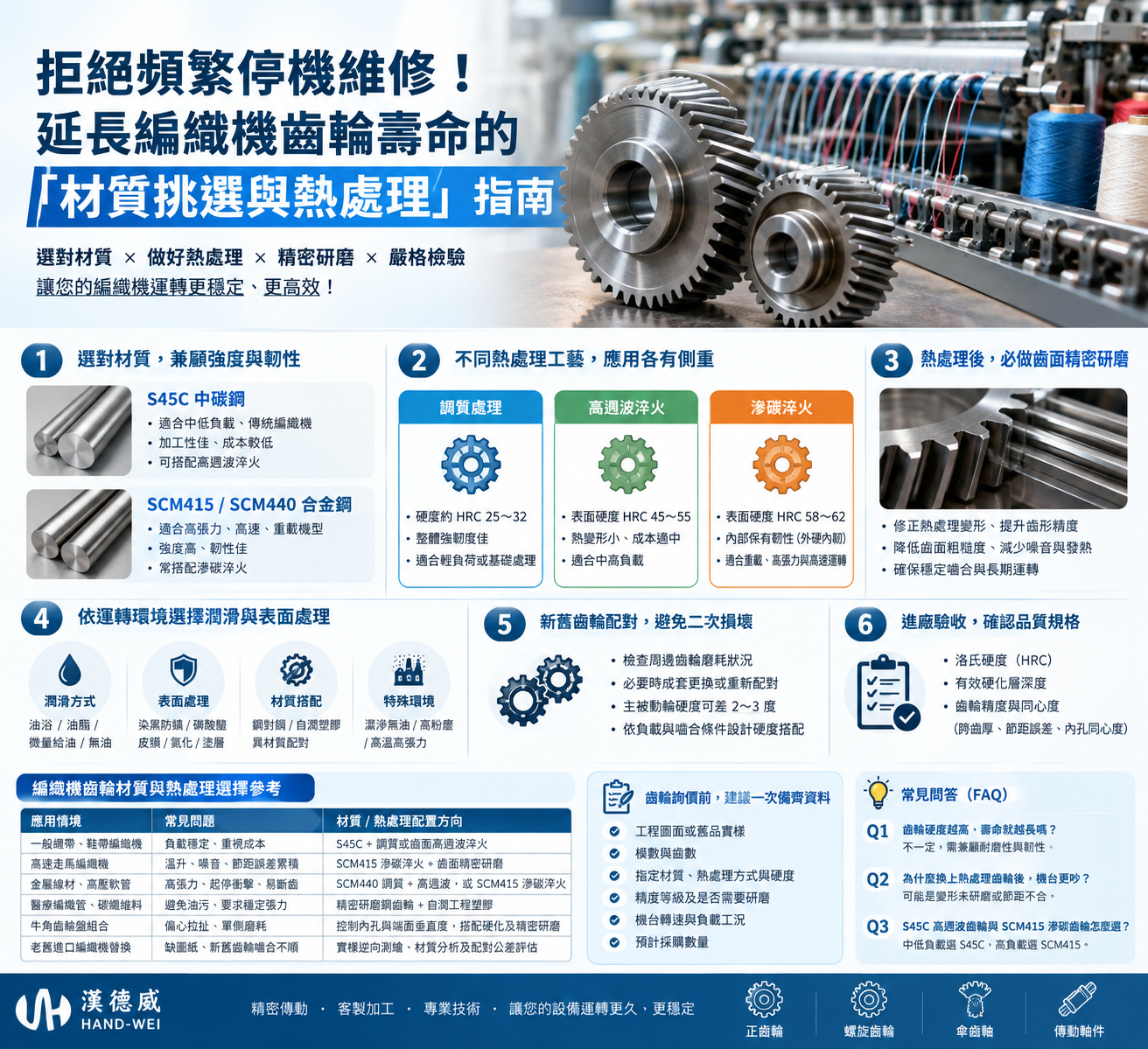
Six Conditions to Check When Selecting Gears for Braiding Machines
Before selecting a gear, check the following six factors:
1. the type of material being braided and its tension, such as ordinary yarn, fiberglass, metal wire, or high-pressure hose;2. the base material, including S45C, SCM415/SCM440 alloy steel, engineering plastics, or composite materials;
3. the heat-treatment method—quench and temper, induction hardening, or carburizing and quenching;
4. tooth-surface machining accuracy and whether precision grinding is needed after heat treatment;
5. lubrication and operating conditions, including oil-bath lubrication, grease, minimum-quantity lubrication, or dry operation; and
6. gear-mesh pairing and acceptance requirements, including the hardness relationship between driving and driven gears and the required hardness, case-depth, and accuracy reports.
The more complete the information, the lower the risk of producing a gear that fits during installation but does not last in service.
I. S45C Medium-Carbon Steel or SCM415/SCM440 Alloy Steel?
Traditional webbing or shoelace braiding machines operating at low to medium speeds and low tension typically have relatively stable loads. S45C medium-carbon steel is commonly used because it offers good machinability and cost efficiency. However, high-speed rotary braiding machines, heavy-duty rope braiders, and equipment processing stainless-steel wire, copper-wire shielding mesh, or automotive high-pressure hoses are exposed over time to high tension and torque shocks during starts and stops. If unsuitable conventional medium-carbon steel is used, metal fatigue may cause cracks at the tooth root, eventually leading to chipped or fractured teeth.
For machines subject to high loads and severe impact, chromium-molybdenum alloy steels such as SCM415 or SCM440 may be considered. With appropriate heat treatment, these steels can provide both strength and tooth-core toughness to absorb impact during emergency stops or inching movements. If the machine is designed for high-tension operation, the material should not be downgraded simply to reduce the cost of an individual part. Selection should still be based on actual loads, speed, structure, and machining requirements.
II. Induction Hardening vs. Carburizing and Quenching: Surface Hardness Is Not the Only Factor
Quench-and-temper treatment (quenching followed by high-temperature tempering) provides relatively uniform strength and toughness throughout the gear. Typical hardness is around HRC 25–32, but tooth-surface hardness is lower, making it suitable for light-duty applications or as a base treatment before surface hardening. Induction hardening is commonly used with S45C or SCM440. Induction heating rapidly hardens the tooth surface to approximately HRC 45–55. This process causes comparatively little thermal distortion and has moderate cost, but the hardened layer may not be distributed uniformly along the tooth-root profile. Tooth-root bending strength should therefore be evaluated carefully under extreme loads.
Carburizing and quenching is commonly applied to low-carbon alloy steel such as SCM415. Carbon is diffused into the surface before quenching, producing a surface hardness of HRC 58–62 while preserving toughness in the gear core—a “hard outside, tough inside” structure. This helps resist tooth-surface pitting caused by continuous meshing and impact under high tension. However, carburizing takes longer, and high temperatures can cause distortion, so subsequent tooth-surface grinding is usually required. Not every gear needs the highest possible hardness; choose the process according to machine speed, load, and operating conditions.
III. Precision Grinding After Heat Treatment Affects Noise and Accuracy
During gear quenching, changes in the metal microstructure can cause expansion and thermal distortion, affecting the tooth profile, pitch, and concentricity that were previously machined. The base of a braiding machine often contains dozens of continuously meshing gears, so small errors in individual gears can accumulate and cause interference, impact, heat generation, and abnormal wear. Heat treatment alone does not guarantee smooth operation, even when the gear surface is sufficiently hard; appropriate post-processing may still be necessary.
Depending on the required accuracy, bore grinding and precision tooth-surface grinding (gear grinding) after heat treatment can correct distortion, reduce surface roughness, and improve meshing quality, resulting in quieter transmission and more stable temperature rise. A quotation request should not simply state “SCM415 carburized and quenched gear.” It should specify the hardness, effective case depth, grinding requirements, and accuracy grade. For example, the design may call for HRC 58–62, an effective case depth of 0.6–0.8 mm, bore and tooth-surface grinding after heat treatment, and JIS Grade 2 accuracy. The final specifications must be confirmed according to gear dimensions and operating conditions.
IV. The Operating Environment Determines Lubrication, Surface Treatment, and Material Pairing
Medical-grade braided tubing, aerospace carbon fiber, and light-colored webbing may not tolerate contamination from lubricating oil, so minimum-quantity lubrication or dry operation may be required. At the same time, yarn fuzz, sizing agents, and metal dust can enter the tooth spaces and cause abrasive wear. If abundant oil cannot be supplied for cooling, steel-on-steel gears may also expand or seize due to frictional heat.
Two approaches can be evaluated according to the operating environment. First, use dissimilar materials in a gear pair—for example, a hardened-steel driving gear paired with a self-lubricating engineering-plastic gear made from MC Nylon, POM, or PEEK composite material—to reduce friction and noise under oil-free conditions. Second, apply suitable surface treatments, such as black oxide for corrosion protection, phosphate coating, nitriding, or low-friction coatings, to improve corrosion resistance, seizure resistance, and wear resistance. For high-speed, heavy-load oil-bath applications, consider SCM415 carburizing and quenching followed by tooth-surface grinding. For high-tension metal-wire applications, strengthen the tooth roots. In clean, oil-free environments, consider pairing precision-ground steel gears with self-lubricating plastic gears. In dusty environments, allow adequate space for debris removal and provide suitable surface protection.
V. Do Not Replace Only the Failed Gear: Check Hardness Matching and Mixed Old/New Gears
When a gear has localized tooth damage, replacing only the failed part may appear faster and cheaper, but it can increase machine noise or cause adjacent gears to fail again. After long-term operation, an old gear may have thinner teeth and a worn or distorted tooth profile. Installing a new gear of standard dimensions may result in poor meshing, point contact, and impact. During maintenance, inspect the wear on neighboring gears. If necessary, service the gears as a set or ask the supplier to match them based on the machine’s actual center distance and tolerances.
The hardness of driving and driven gears can also be differentiated according to the design. For example, a larger gear or spindle gear that is difficult to replace may be slightly harder, while an easily replaced pinion or idler gear may be approximately 2–3 HRC points softer; alternatively, a hard/soft pairing can be used. This can direct some wear toward parts that are easier to replace and protect critical drive components. The actual hardness difference must be designed according to the gear materials, loads, and meshing conditions.
VI. Incoming Inspection: Verify Hardness, Case Depth, and Accuracy
Gears that look identical on the outside may differ in internal hardening and micron-level tolerances. Poorly controlled heat treatment can produce a case that is too shallow, leaving insufficient wear-resistant material after grinding. Excessive carburizing may also embrittle the tooth tips, making them prone to chipping. For high-speed or critical equipment, define inspection requirements before prototyping and mass production, and verify the following at acceptance:
1. Rockwell hardness (HRC): Confirm that tooth-surface and gear-core hardness fall within the design range.2. Effective case depth: Ensure that sufficient wear-resistant material remains after precision grinding.
3. Gear accuracy and concentricity: Use gear-meshing tests or coordinate measuring machine (CMM) inspection to confirm that span measurement across teeth (base tangent length), pitch error, and bore concentricity meet assembly requirements.
Clear inspection criteria help maintain consistent quality between production batches and reduce the risk of line downtime.
Reference Guide: Gear Materials and Heat Treatment for Braiding Machines
| Application | Common Issues | Material / Heat-Treatment Recommendations |
|---|---|---|
| Standard textile-webbing and shoelace braiding machines | Relatively stable loads; cost is a priority | S45C + quench and temper, or induction hardening of tooth surfaces |
| High-speed rotary braiding machines; continuous 24-hour operation | Temperature rise, noise, and cumulative pitch errors | SCM415 carburizing and quenching + precision tooth-surface grinding |
| Metal-wire and high-pressure-hose braiding machines | High tension, start-stop impact, and risk of tooth-root fracture | SCM440 quench and temper + induction hardening, or evaluate SCM415 carburizing and quenching |
| Medical braided tubing and carbon-fiber composites | Avoid oil contamination; maintain stable tension | Precision-ground steel gears + self-lubricating engineering-plastic gears, or evaluate oil-free surface treatment |
| Horn-type gear-disc assembly | Eccentric pulling and one-sided wear | Control perpendicularity between the bore and end face, with hardening and precision grinding |
| Replacement gears for older imported braiding machines | Missing drawings; poor meshing between old and new gears | Reverse-engineering from the physical sample, material analysis, and mating-tolerance assessment |
Prepare the Following Information Before Requesting a Gear Quotation
To shorten evaluation and quotation lead times for custom gears, provide an engineering drawing or the original worn part, module and number of teeth, specified material, heat-treatment method and hardness, accuracy grade, whether tooth-surface grinding is required, machine speed and load conditions, and expected order quantity. If drawings for an older machine are unavailable or the original material and heat treatment are unknown, provide the damaged gear as a sample and describe the material being processed, operating speed, service life, and failure mode (flattened teeth, uneven wear, or broken teeth). This information helps the supplier reverse-engineer the part and assess possible material upgrades.
Frequently Asked Questions (FAQ)
Q1: Do harder gears always last longer?
Not necessarily. Excessive hardness combined with insufficient tempering can make the metal brittle and prone to fracture during high-speed starts and stops or when a broken thread causes a jam. The design should balance surface wear resistance with gear-core toughness. For example, carburized and quenched SCM415 can provide a hard surface while retaining a tough core, but the result must still be verified against the design specifications.
Q2: Why is the machine noisier after heat-treated gears are installed?
The distortion caused by quenching may not have been corrected by tooth-surface grinding, or the pitch of the new gear may not match that of adjacent worn gears. Check the tooth profile, concentricity, and meshing condition. If necessary, service the gears as a set or rematch them.
Q3: How should I choose between S45C induction-hardened gears and SCM415 carburized gears?
S45C induction hardening is faster and generally more economical, making it suitable for medium- and low-load transmission. SCM415 carburizing and quenching usually costs more and may require precision tooth-surface grinding, but it is suitable for main drives, high-tension wire applications, and continuously operating high-speed equipment where wear resistance, fatigue resistance, and stable meshing are priorities. The final selection should be based on load, speed, accuracy, and maintenance conditions.
Stable Transmission Starts with Confirming Material and Heat-Treatment Specifications
For textile machinery manufacturers, wire-braiding equipment suppliers, and production-line maintenance teams, the gear unit price is only part of the total cost. Premature wear and tooth failure can lead to disassembly, repairs, and costly downtime. Every step—from load assessment and steel selection to heat treatment, case depth, post-treatment grinding, and quality inspection—affects whether a braiding machine can operate at high speed reliably over the long term.
HEADWAY specializes in precision mechanical transmission components and custom machining. We provide custom manufacturing and reverse-engineering services for precision spur gears, helical gears, bevel gears, and transmission shafts. Production can follow engineering drawings and JIS/DIN accuracy specifications, and our team can help evaluate materials, heat treatment, and surface-treatment options based on actual machine conditions. Whether you are developing a new generation of high-speed braiding equipment or replacing gears in imported machines, contact the HEADWAY technical team to discuss suitable transmission-component specifications.


