

Pursuing Compactness and Lightness, or Prioritizing Rigidity and Strength?
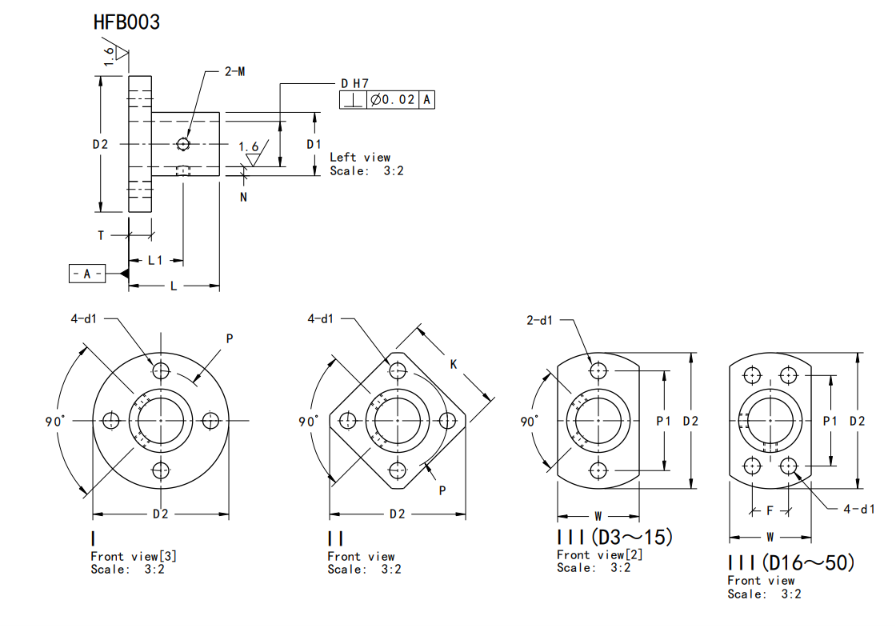
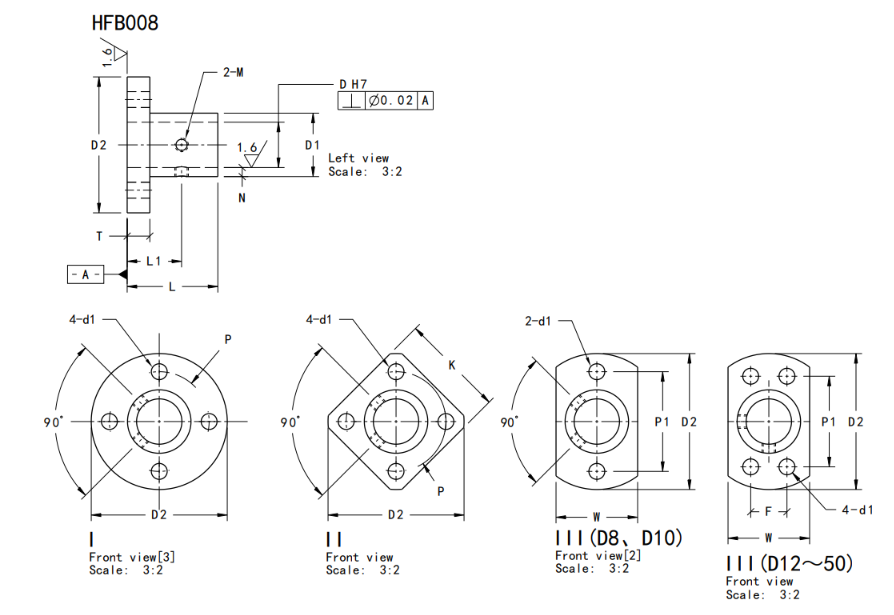
In automation equipment development practices, mechanical engineers often face a trade-off between machine miniaturization and structural vibration-damping rigidity. During commissioning, many machines experience end-effector fixture jitter or slight accuracy drift, which, upon investigation, often stems from insufficient rigidity in the guide shaft holders. While the visually similar HFB003 and HFB008 both meet precision bore tolerances and datum perpendicularity standards, their structural design concepts represent two fundamentally different engineering approaches.
Extreme Space Optimization vs. Dynamic Vibration Damping Margin
In dynamic mechanisms, guide shaft holders fundamentally serve as fulcrums for suppressing vibration.
- HFB003 (Extreme Space Optimization): The core design concept focuses on minimizing the outer body diameter and the projected flange boundary to resolve clearance constraints in tight spaces adjacent to motors or sensors. Its specifications extend downward to cover miniature guide shafts, making it a dedicated choice for miniature precision mechanisms.
- HFB008 (Dynamic High Rigidity): Focused on medium-to-heavy-duty operating conditions, its specifications start from standard shaft diameters. By enlarging the overall profile and base span, it effectively dissipates dynamic shocks and deflection moments during high-speed operation.
The Impact of Barrel Wall Thickness on Fastening Engagement and Deformation Resistance
Securing a guide shaft relies on set screws on the barrel clamping tightly against the shaft. If the barrel wall is thin, excessive tightening torque can easily cause localized micro-deformation of the metal, compromising the original precision fit tolerance. Conversely, insufficient torque can lead to shaft slippage under impact. HFB008 substantially reinforces the barrel wall thickness, which not only provides deeper thread engagement depth to withstand higher tightening torque, but also maintains the circularity of the bore, preventing out-of-round deformation from binding the shaft.
Mounting Hole Count Threshold for Double-Cut Flanges (Type III)
For double-cut flanges designed for confined spaces, the bolt configuration directly determines the anti-overturning capability:
- HFB003: Small-to-medium sizes mostly feature a two-hole fastening configuration, transitioning to four holes only at larger shaft diameters.
- HFB008: Significantly lowers the transition threshold by implementing a four-hole fastening configuration across commonly used medium shaft diameters, substantially enhancing base clamping stability and torsional rigidity within limited mounting widths.
Frequently Asked Questions (FAQ)
Q1: How can one quickly select the right model based on mechanism motion characteristics?
A1: For low loads, short strokes, or ultra-slim guide shafts (less than ∅8), prioritize HFB003. For mechanisms with frequent start-stop cycles, high acceleration, or exposure to lateral cantilever forces, HFB008 is recommended.
Q2: What is the difference between the two models if aluminum alloy is selected?
A2: The shear strength of aluminum alloy is lower than that of steel, making thin-walled structures more prone to thread stripping under repeated tightening. If weight reduction is required while still demanding sufficient tightening torque, the thickened HFB008 provides much more substantial thread support strength.
Q3: Will the thickened model cause mechanical interference in tight spaces?
A3: Yes. Both the outer body diameter and flange width of HFB008 are wider than those of HFB003, requiring a thorough review of 3D spatial boundaries during design planning. If space is extremely constrained, HFB003 should be selected as the primary option.
More Information
The content of this article is based on a specific case study. Actual application results may vary depending on industry characteristics, specification requirements, and operating conditions. The information provided is for reference only.


