

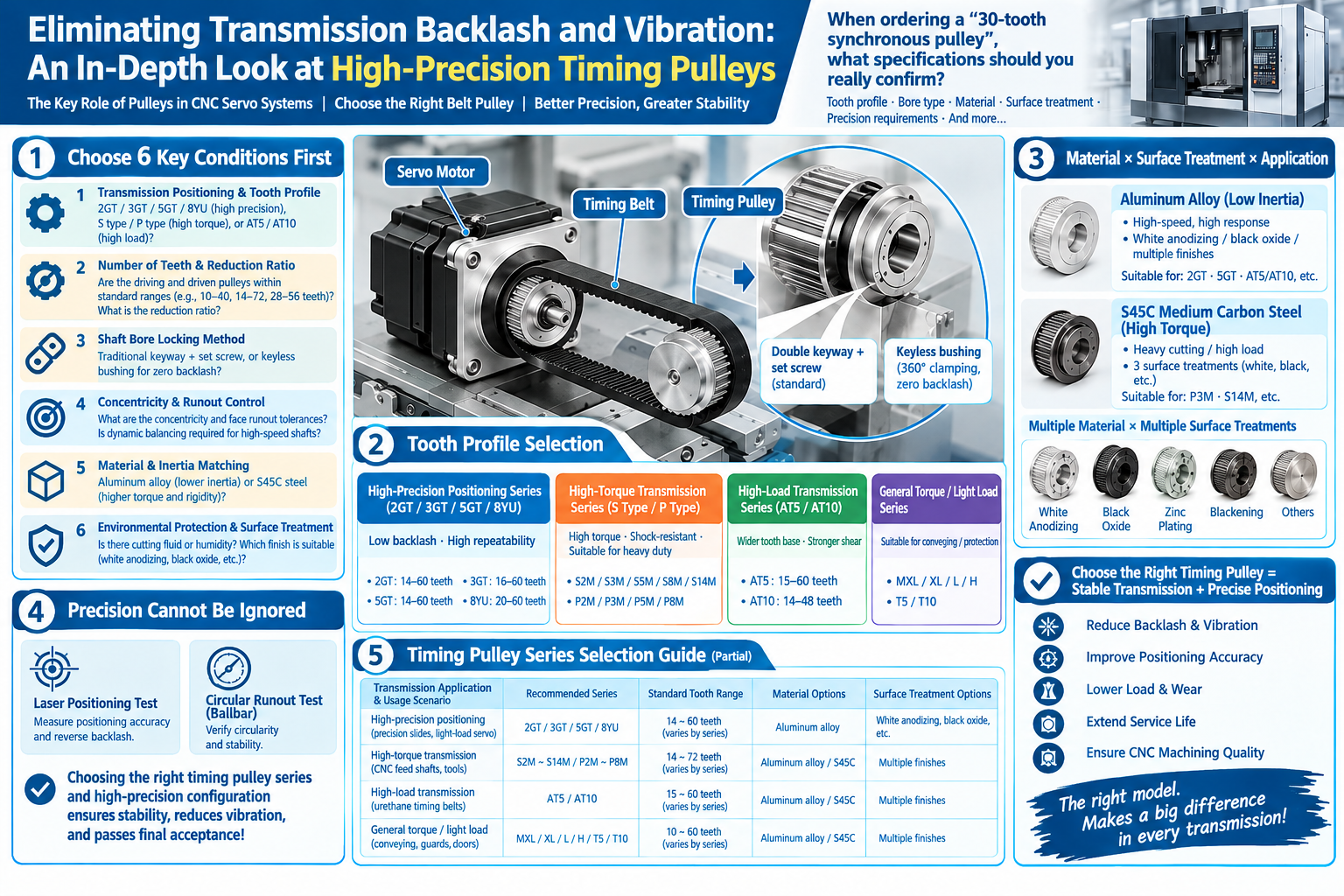
When the Purchase Requisition Only States "30-Tooth Synchronous Pulley," How Should You Specify It?
When a new machine enters assembly or a production-line CNC system undergoes refurbishment, the engineering team hands a bill of materials (BOM) to procurement that simply reads: "For servo motor transmission: purchase 30-tooth timing belt pulley."
This immediately raises a series of questions: Within the same 5mm pitch, should you order the high-torque S5M or P5M, the high-precision positioning 5GT, or the heavy-duty AT5? For heavy-load axes, should you choose S8M, P8M, or S14M? Should the material be aluminum alloy to reduce rotational inertia, or S45C medium carbon steel? For surface treatment, should you select white anodizing or black oxide? Finally, when the machine undergoes laser positioning accuracy acceptance testing before delivery, will the concentricity and backlash of this pulley pass muster?
This is the most common dilemma faced by procurement personnel in the machine tool and automation equipment industries. If you request quotes based solely on the number of teeth and bore diameter—without verifying the tooth profile, shaft locking method, material inertia, and surface treatment—you will often discover chatter marks on the workpiece during test cutting, or excessive backlash that requires machine disassembly and rework.
Therefore, before purchasing a CNC servo timing pulley, the real question to ask is not the unit price, but rather: what positioning requirements the pulley serves, which tooth profile it pairs with, how it locks onto the motor shaft with zero clearance, and what accuracy acceptance standards it must ultimately pass.
⬛How to Select a CNC Servo Motor Timing Pulley? Master These 6 Criteria First
To quickly determine the appropriate timing pulley specifications for CNC servo systems and automation equipment, first verify the following six criteria:
| Selection Criterion | Key Questions to Verify Before Design & Procurement |
|---|---|
| Transmission Positioning & Tooth Profile Series | Does the application require high-precision positioning (2GT/3GT/5GT/8YU), high-torque transmission (S-type/P-type), or heavy-load transmission (AT5/AT10)? |
| Tooth Count Range & Reduction Ratio | Do the driving and driven pulley tooth counts fall within standard specifications (e.g., 10–40 teeth, 14–72 teeth, or 28–56 teeth), and what is the reduction ratio? |
| Bore Locking Method | Does it use a traditional keyway + set screws, or pair with a "keyless bushing" to eliminate forward/reverse impact backlash? |
| Concentricity & Runout Control | What are the tolerances for concentricity between the toothed rim and bore, as well as face runout, and does a high-speed shaft require dynamic balancing calibration? |
| Material & Rotational Inertia Matching | Should you select "aluminum alloy" to reduce inertia, or "S45C medium carbon steel" to enhance high-torque rigidity? |
| Environmental Protection & Surface Treatment | Are cutting fluids and moisture present on-site, requiring white anodizing, black oxide, or other surface treatment solutions? |
I. S5M, P5M, 5GT, or AT5? Start with "Torque Load" and "Positioning Accuracy" Requirements
The very first question encountered when selecting a timing pulley is: "Which tooth profile series should I choose?"
In general auxiliary mechanisms or legacy transmission designs, imperial trapezoidal teeth (such as MXL, XL, L, H) or metric light-duty trapezoidal teeth (such as T5, T10) are commonly used for general torque transmission and light-load conveying. However, in high-acceleration/deceleration, high-response CNC servo systems and precision automation equipment, traditional trapezoidal teeth are prone to meshing clearance (backlash) and stress concentration during frequent forward and reverse rotations.
Taking the timing pulley product line offered on the official HEADWAY website as an example, products for servo and automation transmission are categorized into five main application grades:
- High-Precision Positioning Series (2GT / 3GT / 5GT / 8YU): Specifically engineered for servo mechanisms with stringent requirements for low backlash and high repeatability. Their curvilinear (circular arc) tooth profile enables tight engagement between the belt teeth and pulley grooves, minimizing lost motion during direction reversal:
- Synchronous Pulley - 2GT (14–60 teeth), Synchronous Pulley - 3GT (16–60 teeth): Ideal for compact precision linear stages and high-response, light-load servo axes.
- Synchronous Pulley - 5GT (14–60 teeth), Synchronous Pulley - 8YU (20–60 teeth): Ideal for medium-to-large CNC precision feed axes and high-rigidity positioning mechanisms.
- High-Torque Transmission Series (S-Type & P-Type): Featuring a high-torque curvilinear tooth design that evenly distributes tooth root stress and prevents tooth jumping under heavy loads, serving as the primary specification for CNC machine tool feed axes and tool magazine drives:
- S-Type Series: Includes Timing Pulley - S2M (14–72 teeth), Timing Belt Gear - S3M (14–72 teeth), Synchronous Pulley - S5M (14–72 teeth), Timing Belt Pulley - S8M (18–72 teeth), and the heavy-duty Synchronous Pulley - S14M (28–56 teeth).
- P-Type Series: Includes Timing Belt Pulley - P2M (14–60 teeth), Timing Belt Pulley - P3M (10–40 teeth), Timing Belt Pulley - P5M (12–72 teeth), and Timing Belt Pulley - P8M (20–60 teeth).
- Heavy-Load Transmission Series (AT5 / AT10): When a mechanism uses polyurethane (PU) steel-cord synchronous belts for linear transmission, priority should be given to the Timing Belt Pulley - AT5 (15–60 teeth) or Timing Belt Pulley - AT10 (14–48 teeth), which feature wider tooth roots and stronger shear resistance compared to light-duty T5 / T10 (12–60 teeth) pulleys.
- General Torque / Light-Load Transmission Series: Includes MXL, XL, L, H, and T5 / T10, suitable for peripheral conveying or safety door actuation drives.
II. Traditional Keyway or Keyless Locking? The Key to Eliminating Servo Forward/Reverse Backlash
After selecting the right high-precision positioning or high-torque tooth profile, why does backlash still increase after a period of operation? The problem often lies in how the pulley bore is locked onto the motor shaft.
In the feed axes of CNC machining centers, servo motors perform extremely high-frequency forward and reverse interpolated movements every second:
- Blind Spots of Traditional Keyway + Set Screws: Machining a keyway into the bore and securing it with side set screws is highly susceptible to fretting wear under frequent forward/reverse impacts, which enlarges keyway clearance, while single-sided clamping easily induces eccentricity.
- Zero-Backlash Locking with Keyless Bushings (Taper Lock Bushings): For high-positioning-accuracy CNC servo axes, it is recommended to design the pulley with a precision straight bore paired with a keyless bushing for uniform 360-degree circumferential clamping, completely eliminating keyway clearance to achieve true "zero-backlash" transmission and ensure exceptional concentricity.
III. Concentricity and Runout Determine Surface Chatter Marks
If the concentricity between the pulley's toothed outer diameter and bore is poor (excessive radial runout), or if the end-face perpendicularity is inadequate (excessive axial/face runout), mounting it onto a servo motor will cause:
- Periodic Fluctuations in Belt Tension: Micro-fluctuations in the transmission speed ratio are directly reflected on the machined workpiece surface, forming regular "chatter marks".
- High-Frequency Noise and Flange Wear: Face runout causes the belt to track side-to-side (snaking) during high-speed operation, rubbing against the side flanges and generating high-frequency abnormal noise.
- Accelerated Bearing Wear: Runout at high rotational speeds generates centrifugal force, placing long-term radial stress on the servo motor and ball screw support bearings.
Consequently, when ordering, you must specify finish-machining bore tolerances, material, and surface treatment to ensure concentricity meets high-precision standards.
IV. Material, Tooth Count, and Surface Treatment: Inertia Matching and Environmental Rust Prevention
- High Acceleration/Deceleration, Low Inertia Requirements (Prioritize Aluminum Alloy): In high-speed positioning or high-response feed axes, choosing aluminum alloy reduces rotational inertia. For example, Timing Belt Pulley - P2M and Synchronous Pulley - 2GT use aluminum alloy paired with white anodizing, while AT5 / AT10 also use aluminum alloy and offer 4 surface treatment options.
- High Torque, Heavy Cutting Loads (Prioritize S45C Medium Carbon Steel): When transmission torque is extremely high or tooth root stress is concentrated on a driving pulley with a small tooth count, high-strength S45C must be selected. For instance, the entire Timing Belt Pulley - P3M series uses S45C with 3 surface treatment options, while the heavy-duty Synchronous Pulley - S14M uses S45C with optional black oxide treatment.
- Flexibility of Dual Materials and Multiple Surface Treatments: Series such as high-torque S2M–S8M and P5M, as well as light-duty MXL, XL, L, H, T5, and T10, all offer both aluminum alloy and S45C materials alongside up to 5 surface treatment options, allowing engineers to flexibly configure parts for cutting-fluid environments.
V. Tooth Ratio Between Ends, Flanges, and Belt Specification Compatibility
- Verify Standard Tooth Count Ranges: Configuring the reduction ratio within standard tooth count ranges first (e.g., 10–34 teeth for XL and L; 10–40 teeth for P3M) shortens lead times and lowers customization costs.
- Verify Flange Configuration: High-speed bidirectional mechanisms must rely on double-sided flanges to prevent the belt from tracking off.
- Verify Belt Compatibility: Pair the pulley with a synchronous belt of the exact matching tooth profile, and reserve an appropriate center-distance margin for tension adjustment.
VI. Laser Positioning and Ballbar Circularity Acceptance Testing
For CNC machine tools and automation equipment, once assembly is complete, the system must pass verification using a laser interferometer (measuring positioning accuracy and reversal backlash) and a ballbar (circularity test). Selecting Handway's "High-Precision Positioning Series (2GT/3GT/5GT/8YU)" or "High-Torque Transmission Series (S2M–S14M / P2M–P8M)" ensures transmission rigidity right from the source to smoothly pass acceptance testing.
⬛Practical Implementation & Toolkits
Tool 1: HEADWAY Full-Series Timing Pulley Selection Quick-Reference Table
| Transmission Requirement & Equipment Scenario | HEADWAY Recommended Model Series | Standard Tooth Count Range | Material Options | Surface Treatment Options |
|---|---|---|---|---|
| High-Precision Positioning (Precision linear stages, light-load servo axes) | Synchronous Pulley - 2GT | 14 – 60 teeth | Aluminum Alloy | White Anodizing |
| High-Precision Positioning (CNC feed axes, positioning mechanisms) | Synchronous Pulley - 3GT / 5GT / 8YU | 3GT: 16–60 / 5GT: 14–60 / 8YU: 20–60 teeth | Aluminum Alloy / S45C | 2 Surface Treatments |
| High-Torque Transmission (CNC feed axes, tool magazine drives) | Timing Pulley - S2M ~ S8M | S2M~S5M: 14–72 / S8M: 18–72 teeth | Aluminum Alloy / S45C | 5 Surface Treatments |
| High-Torque Heavy Load (Large CNC spindles, heavy-duty mechanisms) | Synchronous Pulley - S14M | 28 – 56 teeth | S45C | Optional Black Oxide |
| High-Torque Transmission (P-Type) (High-rigidity servo drives) | Timing Belt Pulley - P2M ~ P8M | P2M: 14–60 / P3M: 10–40 / P5M: 12–72 / P8M: 20–60 | Aluminum Alloy / S45C | 3 to 5 Options |
| Heavy-Load Conveying (Long-stroke heavy-duty linear modules) | Timing Belt Pulley - AT5 / AT10 | AT5: 15–60 / AT10: 14–48 teeth | Aluminum Alloy | 4 Surface Treatments |
| Light-Load Conveying (Peripheral conveying, safety doors) | T5 / T10 / MXL / XL / L / H | T5/T10: 12–60 / MXL: 14–72 / XL/L: 10–34 | Aluminum Alloy / S45C | 5 Surface Treatments |
Tool 2: Recommended Information for RFQ (Request for Quotation)
When requesting a quote from Handway, it is recommended to prepare the following details to expedite verification:
1. Model Series: Such as S5M, P5M, 5GT, or AT5.
2. Number of Teeth and Belt Width.
3. Bore Diameter and Shaft Locking Method: Traditional keyway or specified keyless bushing.
4. Material and Surface Treatment Requirements: Aluminum alloy or S45C.
5. Drawings or Photos of the Physical Part: For legacy machine refurbishment or custom specifications, attaching CAD / PDF drawings enables the fastest quotation turnaround.
⬛Frequently Asked Questions (FAQ)
Q1: Given the same 5mm pitch, how should I choose among S5M, P5M, 5GT, T5, and AT5?
The choice should be based on "positioning accuracy requirements" and "torque load magnitude": choose 5GT for high-precision positioning; choose S5M or P5M for CNC feed axes and high-torque transmission; choose AT5 for heavy-load linear conveying, and T5 for light loads. Tooth profiles of different series are not interchangeable and must strictly match the belt.
Q2: Is it better to choose "Aluminum Alloy" or "S45C Medium Carbon Steel" for the pulley material?
Positioning axes requiring high acceleration/deceleration and lightweight design are best suited for aluminum alloy (e.g., 2GT, P2M, AT5), whereas applications involving high torque impact, heavy loads, or small-tooth-count driving pulleys are best suited for S45C (e.g., S14M, P3M). Most of HEADWAY's core series offer both materials for flexible configuration.
Q3: How should I select surface treatments for a CNC machining environment exposed to cutting fluids and moisture?
White anodizing can be selected for aluminum alloy materials (e.g., 2GT, P2M), and black oxide can be selected for S45C materials (e.g., S14M); moreover, most series offer up to 5 surface treatment options, allowing flexible specification of anti-rust solutions based on the machine environment.
⬛Conclusion
For machine tool builders, automation equipment R&D teams, and plant procurement personnel, while the price of a timing pulley is certainly important, what truly impacts cost and delivery schedules is often the backlash, surface chatter marks, and machine disassembly rework caused by selecting the wrong specifications.
From high-precision positioning (2GT / 3GT / 5GT / 8YU), high-torque transmission (S2M–S14M / P2M–P8M), and heavy-load transmission (AT5 / AT10) to general torque and light-load series (MXL / XL / L / H / T5 / T10), every tooth count configuration, material, and surface treatment should be thoroughly verified before placing an order.
HEADWAY Automation Technology currently provides a comprehensive lineup of timing belt pulleys, timing belt gears, and high-precision synchronous pulleys covering complete specifications from 10 to 72 teeth, available in aluminum alloy and S45C materials with up to 5 professional surface treatment solutions, helping R&D and procurement teams quickly confirm the optimal product specifications based on engineering drawings and CNC servo operating conditions. The website's product portfolio also encompasses keyless bushings, couplings, and a wide array of precision mechanical transmission components, serving as a reliable one-stop source for selection and procurement by equipment manufacturers.
(Actual product specifications, secondary bore machining tolerances, and engineering acceptance criteria remain subject to Handway's individual product catalogs, engineering drawings, and contractual specifications.)
Part II. Technical Principles and Standard References (For Technical Endorsement)
If technical specifications or standard references need to be appended at the end of the article, the following international standards and engineering manuals may be referenced:
Tooth Profile Standards and Meshing Theory
- ISO 5296 / ISO 13050 (Curvilinear toothed synchronous belt drive systems): Defines the standards for curvilinear tooth profiles regarding stress distribution and low-backlash transmission.
- Gates Corporation Technical Guide: Provides technical validation for GT/PowerGrip series tooth profiles in reducing tooth clearance/backlash and eliminating reversal dead zones.
- Bando / Mitsuboshi STPD Specification (STS/S-Type Curvilinear Tooth Specification): Establishes high-torque transmission benchmarks for S2M–S14M curvilinear tooth profiles in eliminating stress concentration and preventing tooth jumping (anti-jumping).
Bore-Shaft Locking and Rigid Connections
- DIN 6885 / JIS B 1301 (Key and Keyway Tolerance Standards): Explains fit limits and clearance expansion mechanisms of keyways and parallel keys under alternating torque.
- Friction-Locked Shaft-Hub Connections (Keyless Bushing Taper Friction Transmission Principle): Based on interference fit calculation standards such as DIN 7190, demonstrating that uniform 360-degree expansion clamping eliminates impact reversal backlash.
Machine Acceptance and Dynamic Accuracy Testing
- ISO 230-2 (Determination of accuracy and repeatability of positioning of numerically controlled axes): The international standard for measuring linear axis positioning accuracy and reversal error (backlash) using a laser interferometer.
- ISO 230-4 (Circular tests for numerically controlled machine tools): Circular interpolation testing using a ballbar (QC20 Ballbar), specifically designed to detect axial reversal spikes, servo mismatch, and mechanical backlash.


