

Deciphering Precision Machinery Tolerances: How Geometric Tolerances on Shaft Collar Drawings Impact Positioning Accuracy
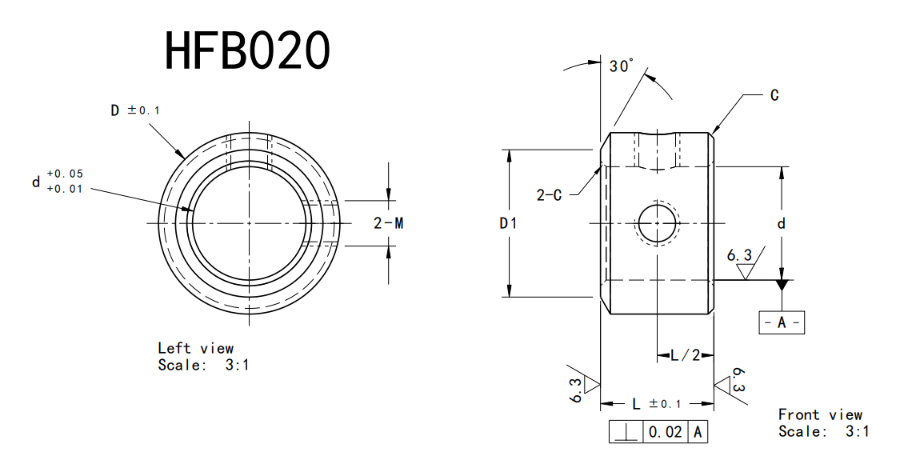
In automated equipment and precision transmission systems, shaft collars play a vital role in component limiting and axial positioning.
Take a standard precision shaft collar (such as the HFB020 series) as an example: its inner diameter dimensional tolerance is controlled within an extremely precise range. This precision clearance fit design ensures that the surface of the precision guide rod is not scratched during assembly, and it generates the most perfect clamping force once the set screws (grub screws) are tightened.
However, what truly dictates positioning accuracy and equipment lifespan is the geometric tolerance for end-face perpendicularity indicated on the drawing: 0.02 | A
This means the end-face runout must be strictly controlled within 20 um. If a low-quality, commercially available alternative that lacks geometric tolerance inspection is used, its end-face non-perpendicularity usually exceeds 50 um. Once tightened, it generates an oblique component force against the axial direction, forcing the guide rod to bend slightly. Furthermore, it subjects adjacent bearings to asymmetrical, eccentric loads, which leads to increased vibration and abnormal heat generation during equipment operation, drastically reducing the machine's Mean Time Between Failures (MTBF).
Headway strictly enforces quality control to ensure that the geometric tolerances of every single shaft collar comply with international brand standards. Whether you require high-rigidity S45C medium carbon steel, corrosion-resistant SUS304 stainless steel, or lightweight aluminum alloy—the top choice for high-speed motion—we can provide products that meet the industry's highest specifications.
If your equipment operates in a high-vibration environment, we recommend implementing alterations on the guide rod surface, such as "flat milling" or "micro-hole drilling". This allows the tip of the set screw to embed itself into the rod, upgrading the tightening mechanism from mere friction to a geometric anti-slip lock.
Welcome to consult the Headway team to build the most stable positioning solutions for your precision mechanisms.


