

Blackening, Nickel Electroless, or Anodizing? Understanding the Environmental Adaptability of Holders for Shaft: Material and Surface Treatment Guide
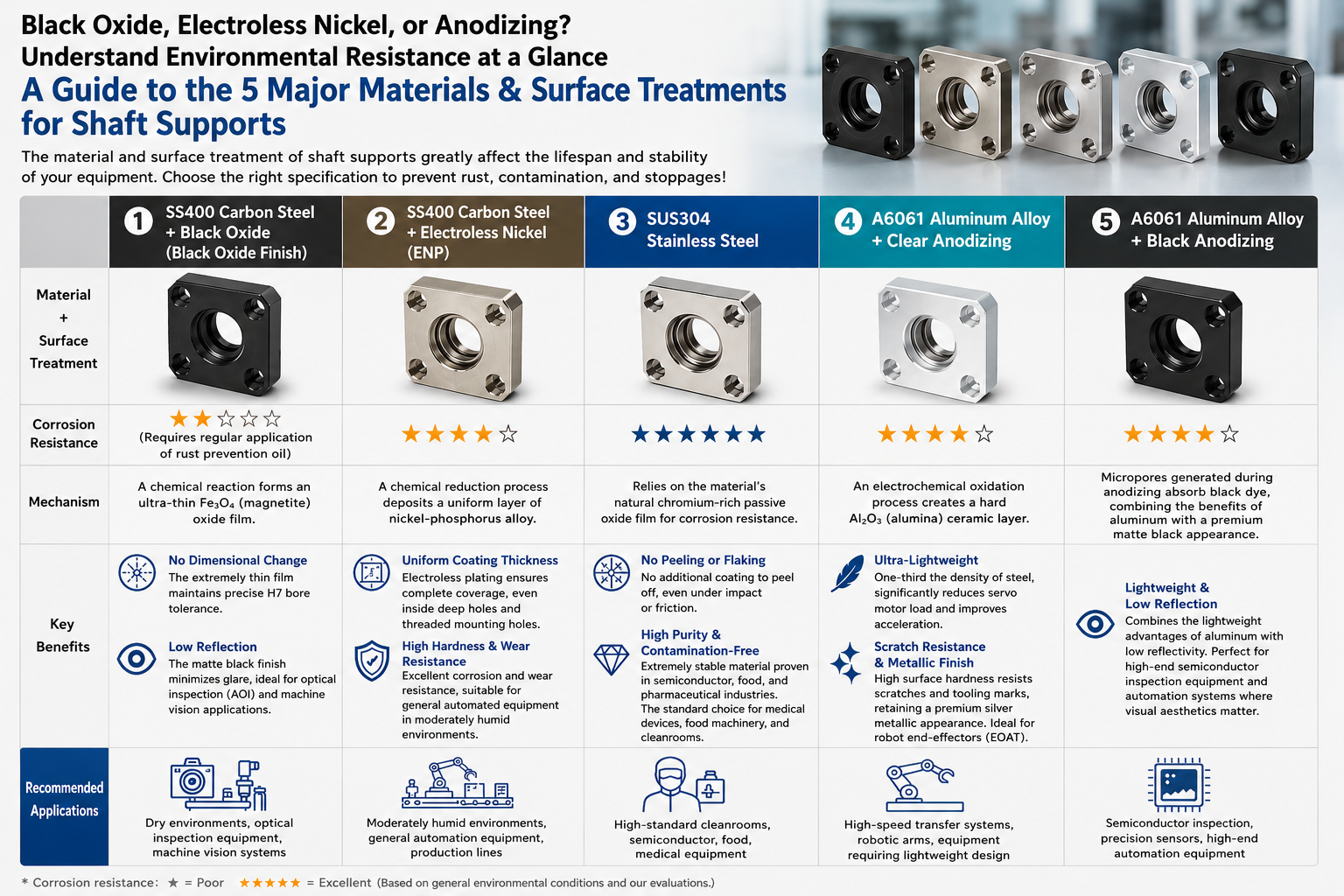
In the design of automation equipment and precision machinery, holders for shaft are the unsung heroes that stabilize linear motion and bear axial loads. When selecting components, many engineers frequently focus on H7 inner diameter tolerances or flange styles, while overlooking the critical impact that materials and surface treatments have on machine lifespan. Choosing the wrong specification can result in cosmetic rusting at best, or trigger dust contamination and mechanical jamming at worst.
With years of deep-rooted experience in manufacturing precision linear transmission components, field machining, and fixture development, we combine industry expertise to analyze the five major materials and anti-rust mechanisms of mainstream flange shaft supports (such as the HFB003 series) below:
Comprehensive Analysis of Mainstream "Material + Surface Treatment" for Flange Shaft Supports
1. SS400 Low Carbon Steel + Blackening
- Anti-Rust Rating: 🌟🌟 (Requires regular application of anti-rust oil)
- Core Mechanism: Formulates an extremely thin Fe₃O₄ oxide film through a chemical reaction.
- Technical Advantages:
- Zero Dimensional Change: Virtually zero film thickness impact, perfectly preserving the H7 precision fit tolerance of the inner diameter.
- Low Visual Reflectivity: The matte black surface is non-reflective, making it the premier choice for automated optical inspection (AOI) and camera vision recognition peripherals.
2. SS400 Low Carbon Steel + Electroless Nickel Plating (ENP)
- Anti-Rust Rating: 🌟🌟🌟🌟
- Core Mechanism: Utilizes a chemical reduction reaction to evenly deposit a nickel-phosphorus alloy layer.
- Technical Advantages:
- Highly Uniform Film Thickness: Eliminates the "sharp edge discharge" issue common in electroplating, ensuring complete coverage even inside deep holes and 2-M screw mounting holes.
- High Hardness & Wear Resistance: Offers excellent rust prevention and friction resistance, making it ideal for standard automation assembly lines in moderately humid environments.
3. SUS304 Stainless Steel
- Anti-Rust Rating: 🌟🌟🌟🌟🌟 (Excellent)
- Core Mechanism: Relies on the material's inherent chromium-rich passive film to resist corrosion; requires no surface treatment.
- Technical Advantages:
- Zero Flaking: Features no additional coating, ensuring it will never peel or flake off under impact or friction.
- High Spec & Contamination-Free: The material is exceptionally stable and has been proven in practice by major semiconductor and food processing factories, making it the sole standard for medical devices, food machinery, and high-specification cleanrooms.
4. A6061 Aluminum Alloy + Aluminum Anodizing
- Anti-Rust Rating: 🌟🌟🌟🌟
- Core Mechanism: Undergoes electrochemical artificial oxidation to generate a hard Al₂O₃ ceramic protective layer on the surface.
- Technical Advantages:
- Extreme Lightweighting: The density is only one-third that of steel, which significantly reduces servo motor load and enhances operating acceleration.
- Scratch-Resistant Metallic Texture: High hardness prevents tool scratches while preserving the original silver-white metallic aesthetic, making it perfect for End-of-Arm Tooling (EOAT) on robotic arms.
5. A6061 Aluminum Alloy + Aluminum Black Anodizing
- Anti-Rust Rating: 🌟🌟🌟🌟
- Core Mechanism: Absorbs black dye through micropores during the anodizing process, combining the benefits of aluminum alloy with a premium matte appearance.
- Technical Advantages: Successfully merges "lightweighting" with "low reflectivity," commonly utilized in high-end semiconductor inspection equipment or automation exhibition machines that demand integrated visual aesthetics.
| Environmental & Mechanical Requirements | Recommended Material & Treatment | Model Suffix Example | Core Selection Rationale |
|---|---|---|---|
| Optical Inspection / Room Temp, Dry | SS400 + Blackening | HFB003-A | Prevents stray light from interfering with lenses; precise dimensions |
| Standard Lines / Moderately Humid | SS400 + Nickel Electroless | HFB003-B | Comprehensive rust prevention inside holes; high hardness and wear resistance |
| Cleanroom / Food & Medical | SUS304 Stainless Steel | HFB003-C | Zero flaking or peeling; resistant to chemical cleaning agents |
| High-Speed Transmission / Robotic Arms | A6061 + Aluminum Anodizing | HFB003-D | Reduces structural weight; decreases motor load and energy consumption |
| Semiconductor Inspection / Visual Aesthetics | A6061 + Aluminum Black Anodizing | HFB003-E | Balances dynamic lightweighting with visual anti-reflection |


